


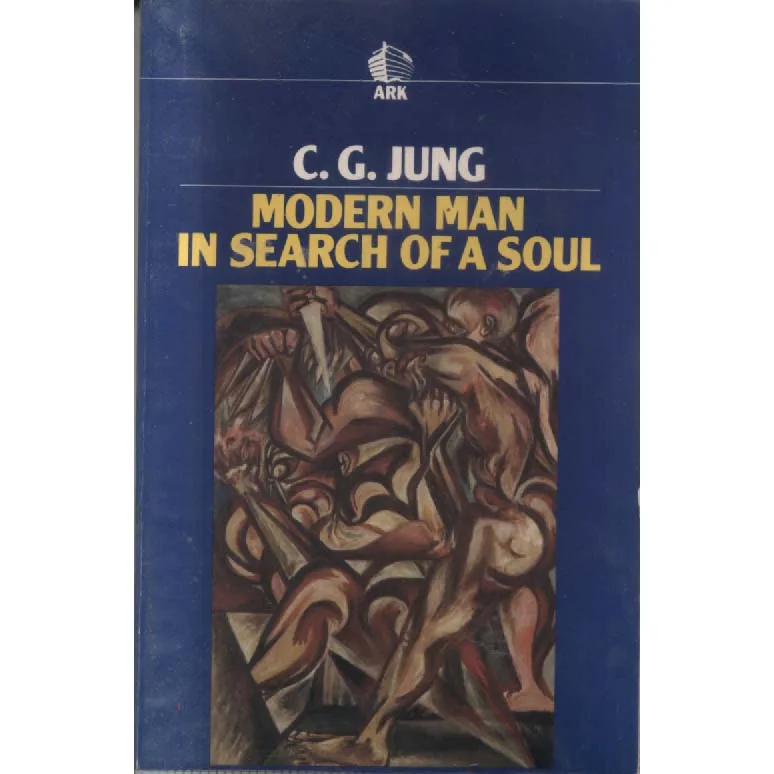
Modern Man In Search Of A Soul
Publisher: Ark
Format: Paperback
ISBN: 9780744800159
Publisher: Ark
ISBN: 9780744800159
Condition: Good
Sold by: Crappy Old Books
An Exploration of the Human Psyche, the Unconscious Mind and Why You Might Not Be Quite the Person You Think You Are
Human beings are extraordinary creatures. We have developed sophisticated technologies, explored the mysteries of the universe, built enormous cities and invented machines capable of communicating instantaneously across continents. Yet despite these magnificent achievements, most of us remain largely incapable of understanding what is going on inside our own heads.
We fall in love with unsuitable people, develop irrational fears, dream about bizarre situations involving former schoolteachers and occasionally wake up at three in the morning wondering whether everybody secretly dislikes us.
Carl Gustav Jung, the celebrated Swiss psychiatrist and pioneer of analytical psychology, devoted much of his life to investigating precisely this sort of psychological nonsense, although he approached the subject with considerably more sophistication than the average self-help guru promising to transform your existence in twelve easy steps.
In Modern Man in Search of a Soul, Jung explores the unconscious mind, dreams, psychological development, spirituality and the difficulties of finding meaning in an increasingly rational and materialistic world.
First published in English in 1933, this collection of essays remains one of the most accessible introductions to Jung’s psychological thinking, although accessible is a relative term when dealing with a man who believed that the human psyche contained archetypes, ancient symbolic structures and enough unconscious material to keep an entire university department occupied indefinitely.
Meet Your Unconscious. It Has Been Making Decisions Without You.
One of Jung’s central propositions was that conscious thought represents only a portion of human psychological activity.
Beneath our everyday awareness lies the unconscious, a vast territory of forgotten experiences, suppressed emotions, symbolic associations and psychological processes that influence our behaviour without necessarily consulting us first.
This is a rather disturbing arrangement.
Most people like to imagine they are reasonably rational individuals, carefully considering their circumstances before making sensible decisions.
Jung suggests that the situation is considerably more complicated.
Dreams, fantasies, emotional reactions and recurring psychological patterns may reveal aspects of ourselves that ordinary conscious thinking fails to recognise.
In other words, the person responsible for your decisions may not be entirely the person you think you are.
Which certainly explains a few things.
Dreams: Your Brain’s Unnecessarily Complicated Nightly Entertainment
Jung regarded dreams as important expressions of unconscious psychological activity.
Rather than dismissing them as meaningless mental debris, he explored their possible symbolic significance and relationship to the dreamer’s emotional and psychological circumstances.
The difficulty, naturally, is that dreams rarely communicate in a straightforward manner.
If your unconscious wishes to express anxiety about your career, it might reasonably explain the problem in clear language.
Instead, it presents a scenario in which you are attempting to catch a train while wearing somebody else’s trousers, accompanied by a talking horse that bears an unsettling resemblance to your mathematics teacher.
Jung believed that examining such imagery could contribute to greater psychological understanding.
His approach differed from that of Sigmund Freud, with whom he had once maintained an important intellectual friendship before their theoretical disagreements produced one of psychology’s more celebrated professional separations.
Freud tended to emphasise particular unconscious conflicts and wishes, while Jung developed a broader symbolic and developmental understanding of psychological experience.
The result was a fascinating disagreement about the nature of the mind, conducted by two men who were presumably exceptionally well qualified to recognise their own psychological difficulties.
Whether they actually did so is another matter.
The Modern World Has Everything Except a Sense of Meaning
Beyond dreams and psychotherapy, Jung was deeply concerned with the spiritual condition of modern humanity.
Scientific progress had transformed civilisation, providing unprecedented knowledge and technological power. Traditional religious beliefs, however, were increasingly questioned, leaving many individuals uncertain about meaning, identity and their place in existence.
Jung believed that psychological well-being could not necessarily be achieved through material success or rational understanding alone.
Human beings also needed to confront deeper questions about purpose, individuality and the unconscious dimensions of experience.
This was an inconvenient observation for a civilisation increasingly devoted to economic productivity.
After all, a person might possess a comfortable home, respectable employment, modern conveniences and an impressive collection of household appliances while still feeling that something fundamental was missing.
Jung’s response was not to recommend purchasing a better refrigerator.
He encouraged psychological exploration, self-understanding and engagement with the symbolic and spiritual dimensions of human existence.
This process was hardly guaranteed to be comfortable.
Discovering previously unrecognised aspects of one’s personality can be considerably more disturbing than simply blaming life’s disappointments on the government.
Psychotherapy: An Expensive Conversation With Unexpected Consequences
Jung also examines the practice of psychotherapy, considering the relationship between patient and therapist and the difficulties involved in psychological healing.
He recognised that individuals cannot always be understood through rigid theoretical systems or treated according to identical methods.
Human personalities are complicated, and psychological difficulties may involve circumstances extending beyond straightforward medical classification.
His discussions reflect an approach that treats the individual as more than a collection of symptoms.
Of course, this creates practical difficulties.
A malfunctioning bicycle can generally be repaired by identifying the defective component and replacing it.
A malfunctioning human personality is rather less accommodating.
There are no standard replacement parts, and the owner may strongly object to being told which components require attention.
Jung’s writings remain historically influential, although many of his more speculative theories are disputed or lack strong empirical support in contemporary psychology.
Nevertheless, his exploration of symbolism, identity and the search for psychological meaning continues to attract readers interested in the deeper complexities of human experience.
About This Copy
This is the 1989 Ark edition of Modern Man in Search of a Soul by C. G. Jung, ISBN 9780744800159.
Condition: Good. A previously owned copy showing ordinary signs of reading, handling and age consistent with its condition grading. A respectable second-hand paperback, suitable for anyone wishing to investigate the mysteries of the unconscious without spending several years undergoing psychoanalysis.
Available from Crappy Old Books, where we believe that old books possess considerable psychological value, particularly when buying them provides a convenient alternative to confronting the enormous collection of unread books already occupying your shelves.
A fascinating and influential introduction to Jung’s ideas concerning dreams, the unconscious, psychotherapy, spirituality and humanity’s enduring search for meaning.
Recommended for students of psychology, readers interested in philosophy and religion, admirers of Jung and anyone who occasionally suspects that their conscious mind is not entirely in charge.
After all, humanity has spent thousands of years attempting to understand the universe.
Jung merely suggested that we might benefit from examining the peculiar little universe between our ears.
And if that sounds unsettling, just remember: your unconscious probably knew you were going to buy this book before you did.
Keep browsing: See more Academic books Other books by CG Jung
